The Diet Trend Report
How are Brits losing weight in 2026?
If you’ve ever Googled for a new diet to try after over-indulging, you’re not alone. One minute, it’s all about intermittent fasting; next, boiled eggs are the answer. Then, suddenly, everyone’s talking about weight loss injections.
Somewhere in between, you’re just trying to eat enough protein, get your veg in, and not spend your entire Sunday batch-cooking a bolognese that will get lost at the bottom of your freezer.
With new diets emerging constantly, we’ve analysed UK search data to see how Brits are navigating weight loss and everyday eating in 2026.
While extreme diets spike and fall in popularity, interest in structured, convenient eating – especially high protein diet meal prep – continues to grow. Not because it’s flashy – because it fits real life.
Four things to know about diet trends in 2026
- Weight loss jabs have gone mainstream. Searches peaked at nearly 1.8 million in a single month in late 2025, and interest in the term jumped almost fivefold year-on-year.
- Some cities are far more interested in weight-loss injections than others. Newcastle and Manchester residents are searching at roughly twice the national average.
- New, niche diets are rising in popularity. The latest round of trending diets are seeing search surges of up to 70% – but nutritionists warn to steer clear of some.
- Most viral diets don’t last long. On average, trend searches dropped by nearly half over two years, with many peaking for just six to eight months before fading.
The diet trend cycle
A diet can go from ‘never heard of it’ to ‘everyone’s doing it’ in a week, then disappear before you’ve even got the hang of it. But while the trends move quickly, the driving force behind them hasn’t changed.
In England, two-thirds (66%) of adults are overweight or living with obesity, according to the recently released Health Survey for England.1 That’s a large proportion of the population thinking about weight, health, or both. It explains why diet-related searches remain high even as specific trends rotate.
What has shifted is where that attention is going.
Interest in weight loss jabs now eclipses traditional dieting
Search interest in weight loss injections has grown significantly over recent years. The term ‘weight loss jabs’ was searched 33,100 times in January 2026 - more than double the amount in January 2025 (+123.6%), when the figure sat at 14,800.
At its peak in August 2025, monthly searches for a mixture of injections reached almost 1.8 million – that’s the equivalent of more than 58,000 searches per day.
Within this category, the injections with the biggest search interest were:
- Mounjaro: 550,000 searches
- Ozempic: 135,000 searches
- Wegovy: 135,000 searches
Mounjaro alone has over twice as many searches as Ozempic and Wegovy combined. This could partly be down to its popularity on social media, with the hashtag #mounjaroweightloss used on more than 114,000 TikTok posts.
This isn’t just online curiosity. A January 2026 study led by researchers at University College London estimated that 1.6 million adults in Great Britain used weight loss medications between early 2024 and early 2025.2 A further 3.3 million said they would be interested in using these drugs in the next year. This means nearly one in 10 adults has either recently used or is considering using weight loss medication.
UK weight loss jab capitals
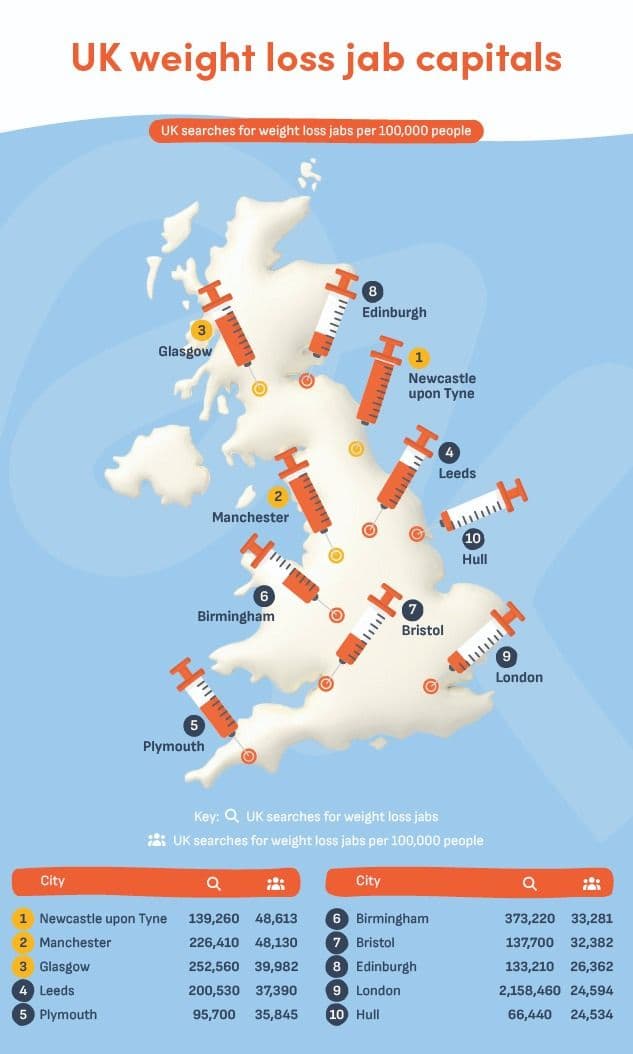
As pharmaceutical weight loss options surge in popularity, we’ve examined search interest per capita across the UK to see where this growing demand is strongest.
Rank
City
UK searches for weight loss jabs
UK searches for weight loss jabs per 100,000 people
1
Newcastle upon Tyne
139,260
48,613
2
Manchester
226,410
48,130
3
Glasgow
252,560
39,982
4
Leeds
200,530
37,390
5
Plymouth
95,700
35,845
6
Birmingham
373,220
33,281
7
Bristol
137,700
32,382
8
Edinburgh
133,210
26,362
9
London
2,158,460
24,594
10
Hull
66,440
24,534
When we normalised search data per 100,000 people, Newcastle upon Tyne topped the list with 48,613 searches. Manchester followed closely at 48,130.
The average across major UK cities was 24,382 searches per 100,000 people, which means Newcastle and Manchester residents are searching at roughly double that rate.
New diet ‘hacks’ are constantly falling in and out of popularity
While the number of Brits researching weight loss jabs significantly dwarfs those looking into more traditional dieting methods, certain diets are still attracting hundreds of thousands of searches each month.
UK Google search interest in top diet trends throughout 2024 and 2025:
Across the country, searches for diet trends dropped by an average of nearly 50% between January 2024 and December 2025 – a decline that runs in tandem with rising public interest in weight loss jabs over the same period.
But for those looking to lose weight the old-fashioned way, three approaches continue to lead the conversation: the keto diet, the Mediterranean diet, and intermittent fasting. At their peak, each of these trends drew between 135,000 and 165,000 searches in a single month, with volumes still as high as 27,100 to 49,500 by December 2025.
Diet trends are moving faster than ever. Where certain approaches once lingered for years, many now peak for just six to eight months before interest starts to drop off. The data shows a rapid cycle fuelled by social media, where new ‘hacks’ can gain visibility almost overnight, prompting a spike in searches before attention shifts elsewhere.
Juice cleansing is a clear example. Searches reached 22,200 in August 2025, up 50% from July and over double the monthly demand seen across much of the previous year, before falling back to 12,100 in September.
Even more niche concepts are also having their moment. The ‘watermelon diet’, which involves eating only watermelon for three days, has also seen brief bursts of search interest – hitting 1,900 monthly searches in July 2025 after trending on TikTok.
However, health professionals have warned that this diet risks muscle loss, a slowed metabolism, and digestive stress, highlighting the importance of not following every social media craze.3
The fastest-growing diet trends
Some diet searches stay steady year after year. Others climb quickly. Looking at year-on-year search volume growth highlights which trends are gaining momentum in 2026. But the pattern isn’t pointing in one clear direction.
The fastest-growing areas span medical weight-loss treatments, highly prescriptive food rules, and more traditional structured eating plans. Rather than a single dominant shift, the data shows interest pulling in different directions at once.
That variation suggests experimentation. With conflicting advice everywhere, people aren’t settling on one approach...they’re investigating and likely trying multiple solutions.
These are the five fastest-growing diet trends in the UK:
Rank
Diet trend
Searches in 2024
Searches in 2025
Year-on-year change
1
Weight loss jab
54,400
314,500
478.1%
2
Boiled egg diet
10,680
18,070
69.2%
3
OMAD diet
59,600
88,300
48.2%
4
DASH diet
86,100
119,600
38.9%
5
MIND diet
16,740
18,880
12.8%
Weight loss jabs
Search interest in weight loss injections rose by 478% year-on-year – the biggest jump in the report. Monthly searches peaked at nearly 1.8 million in August 2025.
Why does it trend? It offers clarity. There’s a defined pathway, without the need for strict or complex dieting. For people who feel stuck cycling through diets, that can feel reassuring. Social and media coverage has also increased visibility, discussion, and confidence.
Why can it be hard to stick to? These treatments still require lifestyle adjustments. Cost, availability, side effects, long-term planning, and weight regain after treatment are becoming valid concerns. There are also questions around how these medications are being used, as they were originally intended for medical conditions like diabetes or obesity. A January 2026 UCL study found that around one in seven people taking weight loss medication were using a drug not licensed specifically for weight loss.2
Boiled egg diet
The boiled egg diet went from 10,680 searches in 2024 to 18,070 in 2025 – an increase of over two-thirds (69.2%). This one is exactly what it sounds like: a short-term plan centred heavily around boiled eggs, usually paired with limited vegetables and lean protein.
Why does it trend? It’s very simple. No tracking apps. No complex meal planning. It’s a ‘tell me what to eat’ plan, which can feel comforting when you’re overwhelmed by diet options and the thought of tracking macros.
Why is it hard to stick to? The same reason people don’t want the same lunch every day. Repetition gets dull quickly. And when food feels restrictive, it can be difficult to maintain. Relying heavily on one food group can also make the diet nutritionally unbalanced, and it may not suit everyone, for example, those advised to support their cholesterol levels with a healthy, balanced diet.
OMAD (one meal a day)
Searches for OMAD – the ‘one meal a day’ diet – rose 48% year-on-year. That's nearly 30,000 additional searches in a 12-month period. The concept is straightforward: eat once, fast for the rest of the day.
Why does it trend? It sounds efficient. One meal means fewer decisions. For people who feel like they’re constantly thinking about what to eat or tracking calories, the simplicity can be appealing.
Why is it hard to stick to? Fitting enough protein, fibre, and overall nutrients into one sitting can be difficult. Hunger levels can vary throughout the day, and long fasting windows may not suit everyone, particularly those who are sensitive to dips in energy or blood sugar levels.
DASH (dietary approaches to stop hypertension)
DASH is a structured eating plan that focuses on vegetables, fruits, whole grains, lean protein, and lower sodium intake. Between 2024 and 2025, this diet rose from 86,100 searches to 119,600, up almost two-fifths (38.9%).
Why does it trend? Compared to viral single-food diets, it looks more like everyday meals. Structured, but not too restrictive.
Why is it hard to stick to? DASH still requires preparation. Fresh ingredients need planning and cooking time, which can be a barrier during busy weeks for people attempting to meal prep.
MIND (Mediterranean-DASH intervention for neurodegenerative delay)
The MIND diet rose from 16,740 searches in 2024 to 18,880 in 2025 – an increase of more than a tenth (12.8%). MIND combines elements of the DASH and Mediterranean eating styles. It often means meals built around vegetables, whole grains, beans, nuts, olive oil, fish, and poultry, with less emphasis on red meat, butter, and pastries.
Why does it trend? It feels sensible and looks like food most people recognise. There’s structure, but not a long list of banned ingredients, which can make it more approachable for long-term lifestyle changes.
Why is it hard to stick to? Like other whole-food approaches, it relies on consistent planning and cooking. Without a clear structure built into the week, even the best of intentions can slip when life gets in the way.
The diets that are losing momentum
For some diets, their time in the spotlight appears to be over. Our research shows that several well-known approaches saw year-on-year drops in search volumes. Often, this can mean:
- The concept is now familiar
- People tried it and moved on
- Or it’s been replaced by the ‘next best thing’
These are the trends that have seen the biggest decrease in search interest:
Rank
Diet trend
Searches in 2024
Searches in 2025
Year-on-year change
1
Intuitive eating
29,700
17,900
-39.7%
2
Carb cycling
56,100
33,880
-39.6%
3
Intermittent fasting
1,071,000
716,600
-33.1%
4
Whole30 diet
22,900
15,500
-32.3%
5
Paleo diet
186,000
135,200
-27.3%
Intuitive eating
Unlike most of the trends in this report, intuitive eating isn’t really a diet at all. It’s an approach that encourages people to tune into hunger and fullness cues, move away from strict restriction, and reduce guilt around food. The number of Brits researching this approach dropped by two-fifths (39.7%) in this period, from 29,700 in 2024 to 17,900 in 2025.
Why did it trend? It offered relief from rigid rules. For people fatigued by dieting cycles, the emphasis on flexibility felt refreshing.
Why is interest falling? Intuitive eating is often discussed through books, podcasts, and social media rather than step-by-step online guides. As a trend, there's also little shock factor and no strict rulebook – both of which contribute to interest spikes seen elsewhere. For those seeking rapid or dramatic weight loss, approaches that promise clearer rules or faster results may naturally attract more attention.
Carb cycling
Carb cycling involves adjusting carbohydrate intake depending on training days, rest days, or specific goals. That often means tracking, planning, and keeping an eye on numbers. Searches for this diet strategy fell from 56,100 in 2024 to 33,880 in 2025 – a 39.6% decline.
Why did it trend? It appealed to people who enjoy structure and precision. The framework feels tailored and goal-driven.
Why is interest falling? It requires planning and tracking. For some, that level of detail can become time-consuming. As priorities shift, simpler routines may feel easier to sustain.
Intermittent fasting
Even after a drop of one-third (33.1%) in annual searches, intermittent fasting remains one of the most popular diets in the report. Searches fell from 1,071,000 in 2024 to 716,600 in 2025 – still a significant volume by any measure.
Intermittent fasting is an umbrella term for eating patterns that limit the hours you eat. Popular versions include 16:8 (fast for 16 hours, eat within 8) and 5:2 (reduced intake on two days a week).
Why did it trend? It offered flexibility around what to eat, focusing instead on when to eat. Variations like 16:8 and 5:2 felt adaptable to different lifestyles.
Why is interest falling? The drop may reflect familiarity rather than rejection. Intermittent fasting has been widely covered for years. There is mixed evidence and ongoing debate around its long-term effects, which may have tempered some of the initial enthusiasm. Fewer people may need to search for the basics because they already understand the framework.
Whole30 diet
Whole30 dropped from 22,900 searches in 2024 to 15,500 in 2025 – a dip of 32.3%. This diet is a 30-day reset-style plan. People typically cut out a long list of foods, including alcohol, sugar, grains, legumes, and dairy, then reintroduce them later.
Why did it trend? The fixed timeframe made it feel manageable. Thirty days can sound achievable, and the ‘reset’ framing appeals to people wanting a fresh start.
Why is interest falling? The rules are strict, and social situations can become complicated. Once people understand the structure, fewer may be inclined to try it out.
Paleo diet
Searches for the paleo diet fell by more than a quarter (27.3%) year-on-year. The thinking behind the paleo diet is pretty simple: cut out grains, skip legumes, and eat like your ancestors. It involves a diet centred around meat, fish, eggs, vegetables, fruit, nuts, and seeds.
Why did it trend? It offered a clear philosophy. Eat whole foods. Cut out processed products. For many, that simplicity felt grounding and natural.
Why is interest falling? It’s been around for over a decade. Most people already know the basics. It also requires label-reading and cooking from scratch, which can be harder to maintain during busy periods.
Not looking for a trendy diet, but a lifestyle change? Learn more about healthy eating plans.
Methodology
Prep Kitchen is a UK healthy meal prep delivery service built around a simple idea: eating well should feel doable, even when life is busy. Founded by owners Mark Morley and William Fishenden, the brand was created to make balanced, high-protein meals more accessible, without sacrificing flavour.
Because we see first-hand how people order, eat, and plan their weeks, we wanted to look beyond viral headlines about diet trends and explore what’s actually happening across the UK. For this report, we analysed:
- Diet trend popularity and trend cycles
We created a seed list of diet trends and weight-loss jabs and used Google Ads Keyword Planner to find the number of monthly UK searches for each over the last two years. For the weight-loss jabs, we combined total searches across various weight-loss injections.
- Regional diet trend interest
For each diet trend and weight-loss jab in the seed list, we counted the number of searches in the top 20 most populous UK cities.
We used City Population to compile a seed list of the 20 most populous cities based on 2021 Census population estimates.
All data was collected in February 2026 and is correct as of then.
Sources
- Health Survey for England, 2024 - NHS England
- 1.6 million UK adults used weight loss drugs in past year - University College London
- Watermelon Diet for Weight Loss - Healthcare On Time